
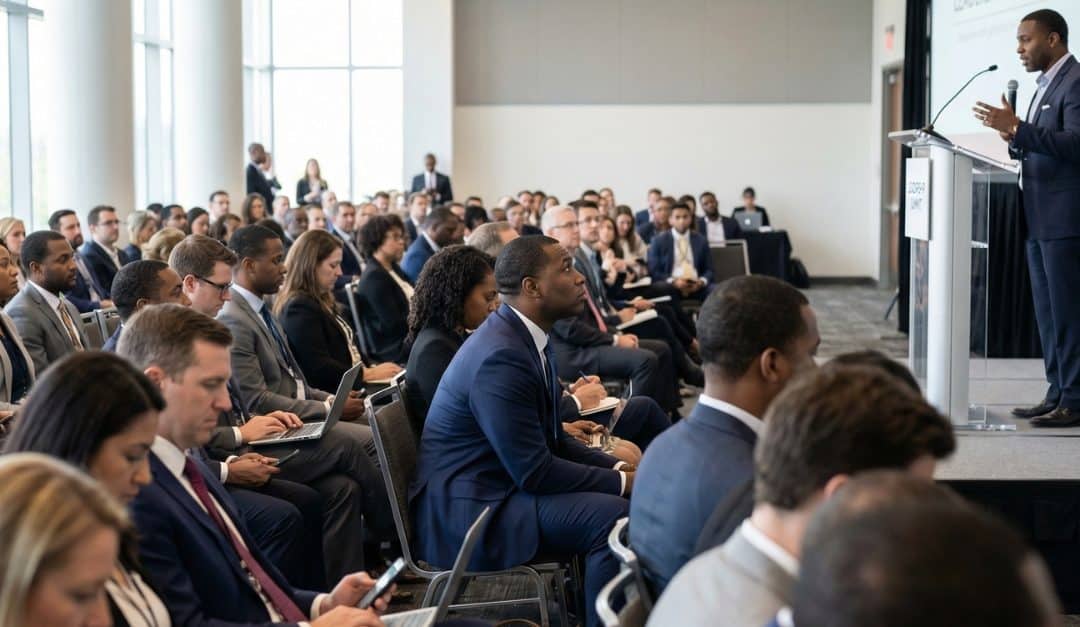
The hall was full—overflowing, really. Chairs packed tight, doors open, people coming in and out, children restless, the familiar low hum of movement that tells you this gathering matters.
A young Malagasy man stood to give his farewell reflections after twenty-four months of volunteer service across Gauteng had come to an end. You could hear it in the room: gratitude, pride, loss.
He walked up to the podium, adjusted the microphone, paused… and smiled.
“Wow,” he said softly, almost amused.
“It’s amazing how quiet and pleasant it is up here.”
He looked out over the audience.
“The stage area is so calm. You can hear every word. Even the air feels nicer.”
Then he contrasted it—with no bitterness, just truth.
“At the back benches, where the overflow doors are open, it’s never like this. You hear people walking in and out. Children running. Noise from other meetings outside. You have to work so much harder just to hear.”
And then came the turn.
“Yet,” he said, “maybe it doesn’t matter where we sit. We’re all in the same meeting. We share the same spirit, the same message. What differs is how much effort each of us must invest to benefit from it.”
Something about the way he said it—calm, lived-in, unresentful—revealed experience. This wasn’t a metaphor he had borrowed for an impressive podium talk. It was a metaphor he’d occupied. More than once. For reasons not always of his choosing.
And as he spoke, a quiet interrogation rose in me.
How fair is this, really? How fair is life?
Who decides where we sit in the hall of life?
Our proximity to comfort? To clarity? To resources? To opportunity?
How much of our seating is circumstance—and how much is choice?
The lens was quickly turning inward. Awkwardly.
How have I handled my own station so far?
When I’ve found myself closer to the front, did I invest that privilege into my future—or squander it on that moment’s comfort?
Did I use my access to advocate- and move if needed- for others who needed my seat more than I did at that moment?
And when I was pushed to the noisy, restless back benches—the place of latecomers (those we foolishly label ‘late bloomers’ in life) —how did I respond?
Did I complain and grow bitter?
Or did I listen more intently?
Did I lean forward despite the noise?
Did I reach out, ask for space, please for more order and quiet among my surrounding benches? Did I create alliances, learn names, which would allow me better sightlines or an invite to an open seat in the better parts of the hall?
Then came the most unsettling realization of all:
In many cases, the seating was a choice. Mine and everyone’s.
A choice of when to wake up.
A choice of when to arrive.
A choice of who I wanted to sit next to.
A choice of what behavior, reverence, and discipline I modelled for my children—knowing that would determine whether I’d be confined to the back benches near the exit, or free to choose my seat.
Not all inequality is chosen. Our modern world proves that. Let’s be clear.
But not all of it is imposed either.
And the damming truth is this:
The hall doesn’t change.
The meeting goes on.
The speakers keep speaking.
What changes is how we position ourselves, and how intentionally we respond to where we are placed—temporarily or otherwise.
So? Yo?
Where are you sitting in the theatre of your life right now? —what are you doing with that seat?
Your Call to Action
This week, I challenge you to not just attend the meeting of your life as a spectator—position yourself for full benefit.
Arrive earlier. Lean forward. Invest your privilege. Advocate where you can.
And if you’re in the back benches, resist bitterness, don’t squander precious energy —build capacity, clarity, and a sharper ear.
The hall is full.
The message is being delivered.
The question is no longer where you sit.
It is: what will you do with the seat you’ve chosen—or been given?
Vusumuzi (Dominic) Tshabalala
Is your leadership shaped by circumstance or by choice? Click here and connect with us to explore how intentional leadership development can strengthen the way you lead and serve your organisation.
Explore more leadership insights in our MCA Blog.